
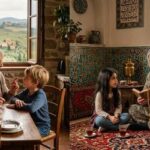
October 2nd is celebrated in Italy Grandparents' Day.
A bridge between Italy and Iran: how seniors resist modern isolation by becoming the emotional, cultural, and economic cornerstone of families.
October 2nd is celebrated in Italy Grandparents Day, a celebration that invites us to reflect on the social value of the elderly, central figures not only in our country, but also in seemingly distant cultures like Iran. In both societies, grandparents are the guardians of the intergenerational transmission of living memory: a legacy of stories, traditions, and values not found in textbooks, but passed down through the power of oral storytelling.
Whether it is the testimonies of peasant life and the post-war period in the Italian countryside, or the narratives of ancient Persian fairy tales and the recent Islamic Revolution told around the hearth in Iran, grandparents act as real cultural bridgesThis lived memory educates new generations in a sense of belonging and resilience, transforming the past into a beacon for orienting themselves towards the future.
From the perspective of social change, Italy and Iran face different demographic challenges, but they share a profound transition that is redefining the role of seniors. Italy is one of the oldest countries in the world, where grandparents are now an irreplaceable resource for financially supporting precarious children and caring for grandchildrenIran, despite having a historically younger population, is experiencing a rapid demographic aging that is putting traditional social structures to the test. In both contexts, however, the figure of the grandfather has been stripped of all passivity: today he represents an active role and a fundamental pillar to maintain social cohesion in times of great historical and financial uncertainty.
Finally, the experience of these two countries highlights the strength of community networks, capable of resisting modern commodification. In contemporary societies, dominated by speed and profit, time and care are often outsourced and monetized. Yet, both in small Italian villages and in the densely populated neighborhoods of Iranian cities, an extended family model persists in which internal solidarity prevails over market logic.
The grandparents' house remains a safe haven, a place outside of commercial time where relationships are still based on generosity, affection, and mutual respect. This safety net represents a crucial form of cultural resistance, the only one truly capable of protecting the most authentic human bonds from the isolation and individualism of the modern world.