
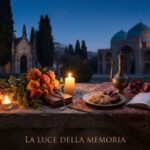
All Saints, the Commemoration of the Dead.
The first days of November bring with them, in the European and Italian tradition, a particular quality of time. The liturgical and civil calendar invites us to a double pause of the spirit: November 1st, with the solemnity of All Saints, the gaze is raised towards the vertical dimension of holiness, celebrating those who have fully achieved closeness to God; on November 2nd, with the Commemoration of the Dead, the gaze becomes horizontal and intimate, embracing in memory and prayer the family affections and the generations that preceded us.
This double movement – the aspiration to spiritual perfection on the one hand and the loving preservation of memory on the other – does not represent an isolated experience of the Christian West, but it touches universal chords that find an extraordinarily similar resonance in the history, theology and culture of Iran.
The “Friends of God”
From a historical-religious point of view, the Christian concept of Communio Sanctorum the spiritual communion that binds the faithful of the earth to those who already enjoy the beatific vision dialogues profoundly with the Islamic doctrine of Walayah (spiritual proximity and divine friendship). In Islamic thought, and with particular intensity in Shiite spirituality and Persian mysticism (invention), the saints are defined Awliya Allah, the “Friends of God”.
“Verily, the friends of God will have no fear, nor will they grieve.” (Quran, 10:62)
As in the Catholic tradition, on November 1st we do not only celebrate the canonized saints but also the silent multitude of the righteous, thus in Iranian spiritual culture the veneration for the Pure, the wise men and mystics are accompanied by the recognition of a hidden sanctity, woven with daily rectitude. Pilgrimage to the tombs of the saints and descendants of the Prophet (Ziyarat) is never perceived as a tribute to an inert past, but rather as a live encounter: the saints are clear mirrors that reflect the divine light and intercede with the Most High, keeping open the bridge between the sensible world and the spiritual world.
Remembrance Thursday
If Italy dedicates a solemn day to the deceased at the beginning of late autumn, In Iranian tradition this event is repeated cyclically every week, finding its peak also on the eve of the solar new year (Nowruz) and on the sacred nights of the lunar calendar. Every Thursday afternoon, at sunset which introduces Friday (Shab-e Jom'eh), Iranian families go to cemeteries to visit their loved ones.
In the Islamic theological vision, Death does not interrupt the bond of love and mutual responsibility between the living and the deceased. Souls dwell in the barzakh the intermediate world, comparable in many respects to the dimension of waiting and purification of Christian theology and draw relief, light and consolation from the prayers and good works done in their name on earth.
Rose water and charity
The anthropology of the rite reveals touching parallels between the gestures performed in Italian cemeteries these days and those preserved in Iran. Where in Italy chrysanthemums are placed and votive candles are lit to symbolize faith in the resurrection, In Iran, tombstones often placed horizontally in contact with the earth are washed with pure water and sprinkled with golab (rose water), whose scent recalls the fragrance of a heavenly garden and soothes the pain of separation.
Alongside the lighting of candles and the recitation of the Surah al-Fatiha (the opening prayer of the Quran, true functional equivalent of theEternal rest Christian), the heart of the Iranian rite lies in the Kheyrat, the charitable offering for the peace of the soul of the deceased (Shadi-ye Ruh). Families prepare the food at homeHalva a traditional dessert made with toasted flour, butter, rose water and saffron and distribute it together with dates, fruit and bread to passers-by, to neighbors and those in need. This custom, which closely recalls the ancient Mediterranean and Italian tradition of "sweets for the dead" and of bread shared in suffrage for the souls, transforms private mourning into a gesture of community solidarity: the memory of those who are no longer here becomes nourishment for those in need, and the thanks of the person receiving the gift immediately turns into a prayer of light for the deceased.
Millenary roots
The historian's gaze captures in these practices a millenary continuity that spans civilizations. Since pre-Islamic antiquity, The Iranian plateau celebrated the indissoluble bond between generations through the days dedicated to Fravashi, the guardian spirits and souls of the ancestors, symbolically welcomed into illuminated and purified homes. With the advent of Islam, this deep sensitivity to genealogical memory has not been erased, but it has been sublimated and recast in the luminous Quranic theology of divine mercy and eternal life.
Likewise, the language of funerary and sacred art of both worlds shares ancient archetypes: il cypress (Sarva), which stands silently in Italian cemeteries as well as in the historic gardens of Shiraz and Isfahan, is for both cultures the symbol of the immortality of the soul that tends towards the sky; pomegranate, autumn fruit par excellence, It represents both in Christian iconography and in Persian poetry the mystery of unity in multiplicity and the promise of rebirth.
Death as a threshold
Sealing this meeting between traditions is the voice of great Persian poetry, which for centuries has educated the human soul to look beyond the veil of transience. For the great masters of Iranian thought, stopping at a tomb does not mean contemplating nothingness, but to listen to the echo of a life that has simply changed its home. As he wrote in the 13th century Jalal al-Din Rumi (Molana) in verses destined to resonate as a universal testament:
“On the day of my death, when my coffin is carried, do not think that I feel sorrow for leaving this world. Do not cry and say, 'What a pity, what a pity!' When you see my body laid in the tomb, do not say, 'Goodbye,' for the tomb is but a veil that hides the gathering of Heaven.”
The Hafez of Shiraz, the supreme lyric poet whose tomb is itself the destination of an incessant spiritual pilgrimage, he remembered that the tomb of those who have lived in love and truth is destined to be surrounded by everlasting grace, transforming itself into a beacon for travellers.
Celebrating All Saints' Day and the Commemoration of the Dead by looking at the cultural bridge between Italy and Iran therefore means rediscovering a shared truth: A civilization measures its moral greatness by its ability to honor its righteous and not forget its fathers. In the silent gesture of someone who lights a candle in a church in Rome or of someone who pours rose water on a tombstone in Shiraz, humanity speaks the same language: that of gratitude, of hope and a love that time cannot consume.