
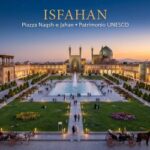
47 years after its inscription on the UNESCO World Heritage List.
Il October 26, 1979 represents a fundamental date for the protection of global cultural heritage: on that day, the monumental square of Naqsh-e Jahan in Isfahan was officially inscribed on the UNESCO World Heritage List, together with Persepolis and Chogha Zanbil, becoming one of the first three Iranian sites to receive this prestigious international recognition.
Celebrating this anniversary means paying homage not only to an architectural marvel, but to one of the highest expressions of urban planning, of the spatial philosophy and cultural identity of the Iranian plateau.
The imperial vision of Shah Abbas the Great
At the end of the 16th century, precisely in the 1598, the Safavid ruler Shah Abbas I He decided to move the empire's capital from Qazvin to Isfahan, a more central, fertile, and strategic location along the Eurasian caravan routes. Under the guidance of the architect, mathematician, and philosopher Sheikh Bahai, the city was redesigned according to a revolutionary master plan based on two axes: the tree-lined avenue of Chahar Bagh (“Four Gardens”) and the immense rectangular esplanade of Naqsh-e Jahan, literally “The Image of the World”.
It was not just a public space, but of a political and cosmological manifesto: to concentrate in a single visual horizon the totality of the known world, its commerce and its arts. It was precisely the amazement of the travellers, European merchants and ambassadors faced with such magnificence coined the famous Persian saying:
«Esfahān nesf-e jahān» Isfahan is half the world.
Archaeology and architecture of a sacred and profane space
From an archaeological and urban planning point of view, the Square It still amazes today with its colossal proportions: 560 meters long by 160 meters wide (almost 9 hectares of surface), surrounded by a double row of symmetrical porticoes in brick and majolica with around 200 arches.
The design genius of Naqsh-e Jahan lies in the perfect synthesis of the four pillars of Safavid society, each embodied by a monumental masterpiece placed on one of the four cardinal sides:
-
The Religious and Congregational Power (South Side) – The Great Mosque: Iniziata nel 1611, it is the triumph of ceramics haft-rang (“seven-colored”). Since the square is oriented along the north-south axis while the Qiblah (the direction of Mecca) required a southwest orientation, The architects created a curved entrance corridor that rotates the axis of the building 45% without the visitor perceiving any asymmetry from the outside. Its double dome, 53 meters high, It features perfect acoustics capable of amplifying the human voice up to seven distinct echoes.
-
Mysticism and the Private Court (East Side) – Sheikh Lotfollah Mosque: Without minarets or an internal courtyard as it was reserved for the sovereign and the court, It houses one of the most refined domes of Islamic art. Its cream-colored tiles change shades from pink to ivory following the course of the sun, while inside the geometric design converging at the centre of the vault reproduces the feathers of a peacock's tail illuminated by the light.
-
The Political and Imperial Power (West Side) – The Palace of Ali Qapu (The Sublime Porte): Six stories high and 48 meters high, It served as a sacred threshold to the royal gardens behind. From its majestic speaks (the loggia supported by eighteen columns made of plane wood), The Shah attended military parades and polo matches. On the top floor opens the famous Music Hall, where deep stucco niches carved in the shape of amphorae and vases had not only an aesthetic function, but they acted as acoustic traps to absorb the reverberation of the court musicians.
-
The Economic and Mercantile Power (North Side) – The Qeysarie Portal: The monumental entrance to the Grand Imperial Bazaar, beating heart of the Silk Road economy. On the upper lunette are still visible the frescoes celebrating Shah Abbas's victories against the Uzbeks and the singular majolicas depicting the Sagittarius (zodiac sign linked to the foundation of the city in the Persian astrological tradition).
At both ends of the square, a precious archaeological detail still survives today: le ancient stone doors of the Chogan, the Persian ancestor of the game of polo, practiced by the royal cavalry right in the centre of the esplanade.
A living heritage
Unlike many archaeological sites frozen in the past, Naqsh-e Jahan continues to breathe. The hammering of the master coppersmiths still resounds under its arches (mesgar), the miniaturists' brush on camel bone, the art of khatam-kari (Persian inlay) and fabric printing (qalamkari).
Remember the October 26, 1979 means reaffirming the universal value of a place where hydraulic engineering, sacred geometry, Visual poetry and the dialogue between civilizations have merged to give humanity as a whole a mirror of timeless beauty.