
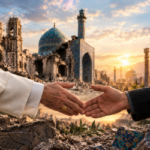
War must not erase our heritage.
The recent escalation of the conflict in the Middle East is inflicting incalculable damage not only on civilians but also on humanity's historical and spiritual heritage. As reported by OTRA PressSeyed Reza Salehi Amiri, Iran's Minister of Cultural Heritage, Tourism and Handicrafts, addressed a heartfelt appeal to Pope Leo XIV, documenting the devastation of priceless archaeological and religious sites following the recent bombings.
Damage to places of worship and historical sites The technical assessments released by the Iranian Ministry paint a dramatic picture: 149 monuments across 18 provinces have suffered structural damage of varying degrees. The destruction has severely impacted the symbolic sites of interfaith coexistence that has characterized the country for centuries. Among the most serious losses are the repeated damage to the Orthodox Church of St. Nicholas in Tehran and a historic church in Isfahan. Even more tragic is the fate of the Rafinia Synagogue in Tehran, the nerve center of the Iranian Jewish community, which was completely destroyed along with the ancient copies of the Torah housed there.
Requests for intervention to the Holy See Recalling international humanitarian law and the 1954 Hague Convention on the Protection of Cultural Property in Armed Conflict, Minister Amiri appealed to the moral authority of the Pontiff to urge three concrete actions:
-
A strong appeal to the international community to ensure the safety of civilians and absolute respect for places of worship of all faiths.
-
Support for the launch of an international, impartial, and independent cataloging of the damage inflicted on Iran's historical heritage.
-
The opening of a channel of technical cooperation between Holy See experts and Iranian institutions to manage the safety and restoration of damaged monuments.
The full text of the letter
To His Holiness Pope Leo XIV, Supreme Pontiff of the Catholic Church,
Holiness,
At a time when the world needs peace, dialogue, and the moral guidance of those entrusted with great responsibilities more than ever, I wish to draw Your Holiness's attention to a wound inflicted by war, not only on human lives, including those of Iranian civilians, but also on a part of humanity's historical memory and spiritual heritage.
During the recent military attacks conducted by the United States and the Israeli regime against Iran, in addition to the loss of human lives and damage to homes and civilian infrastructure, a significant number of historic buildings, urban and architectural complexes, and archaeological sites have suffered damage. Technical assessments conducted by the Ministry of Cultural Heritage, Tourism, and Handicrafts of the Islamic Republic of Iran indicate that 149 historic monuments and sites, spread across 18 provinces of the country, have sustained varying degrees of damage.
Some of these properties are inscribed on the Iranian National Heritage List, while others are recognized for their historical, cultural, and religious value.
Among these losses, the damage inflicted on places of worship belonging to revealed religions is a source of particular sorrow. The Orthodox Church of St. Nicholas in Tehran suffered damage on two separate occasions due to nearby explosions. For the Orthodox Christian community in Iran, this church represents much more than a simple building: it is a place of prayer, memory, and spiritual bonds passed down from generation to generation. Similarly, a historic church in Isfahan was not spared the consequences of military attacks.
Tehran's Rafinia Synagogue, one of the active religious centers of the Iranian Jewish community, was also completely destroyed. This synagogue was a precious part of the religious heritage and collective memory of Iranian Jews and housed ancient copies of the Torah. The state of conservation of several religious heritage sites still requires further assessment, emergency safety measures, and meticulous documentation.
Attached to this letter, I have the honor to submit for your attention, for the benefit of the relevant institutions, documentation relating to the destruction and damage suffered by historical and religious buildings and monuments in Iran. This material attests to the extent of the damage inflicted on the country's cultural and spiritual heritage and can serve as a basis for technical assessments, documentation and registration activities at the international level, as well as for the adoption of appropriate measures to safeguard this invaluable heritage.
Holiness,
Iran is a land with a long tradition of interfaith coexistence. In our historic cities, mosques, churches, synagogues, and fire temples are not isolated elements in a geographical landscape; they are distinct chapters of a single book called Iran. Over the centuries, Christians, Jews, Zoroastrians, and Muslims of this land have contributed to shaping Iran's culture, art, architecture, and historical identity. Consequently, an attack on any place of worship is not only an offense to the followers of a particular religion, but also a wound to humanity's shared heritage and the historic tradition of tolerance and coexistence.
Even in the midst of conflict, cultural heritage must never become a target or a victim of military hostilities. The established principles of international humanitarian law and the 1954 Hague Convention for the Protection of Cultural Property in the Event of Armed Conflict recognize the protection of cultural heritage as a responsibility that transcends political boundaries. The destruction of a historic monument does not merely impoverish a nation's heritage; it deprives future generations, everywhere, of an irreplaceable component of humanity's collective memory.
In light of Your Holiness's eminent spiritual stature and your constant commitment to peace, human dignity and interreligious dialogue, I respectfully appeal to Your Holiness to:
First, it urges the international community and the parties responsible for the hostilities to respect and protect civilian lives, places of worship, and cultural heritage, reiterating that churches, synagogues, mosques, and other sacred sites must be protected from military attack.
Second, support international and independent documentation of the damage done to Iran's cultural and religious heritage, so that the extent of these losses can be recorded objectively, independent of any political considerations, and preserved for the historical memory of humanity.
Third, it promotes cooperation between the Holy See's cultural and specialized institutions and Iranian experts in the emergency protection, recovery, and restoration of damaged religious and historical monuments.
The Ministry of Cultural Heritage, Tourism, and Handicrafts of the Islamic Republic of Iran stands ready to provide the Holy See's cultural and specialized institutions with technical reports, photographs, supporting documentation, and a detailed inventory of the affected sites. The Ministry welcomes all forms of scientific, technical, and professional cooperation in this regard. Written documentation regarding the destruction and damage suffered by historic and religious buildings is also attached to this letter, to facilitate a more thorough examination of the matter and a better understanding of the extent of these losses.
Today, defending a church, a synagogue, a mosque, or any other sacred place doesn't mean defending one religion against another. It means defending humanity against violence, memory against oblivion, and the possibility of dialogue against the destructive logic of war.
I pray for the health of Your Holiness and for the continued success of your mission, and I express my hope for a world in which the sound of church bells, prayers in synagogues, and the call to prayer from mosques can resound not amid rubble and explosions, but alongside one another, in a climate of peace.
Please accept, Your Holiness, the assurance of my highest consideration and profound respect.
Seyed Reza Salehi Amiri
Minister of Cultural Heritage, Tourism and Handicrafts of Iran
Source: OTRA Press