
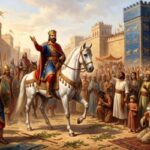
On October 29, Iran celebrates the founder of the Achaemenid Empire.
A journey into the history of the emperor who replaced the brutality of the conquerors with respect, laying the foundations for the first declaration of human rights.
The Triumphal Entry and the “Father of the Fatherland” On October 29, Iran celebrates, unofficially, Cyrus the Great Day. This celebration, established in the early 2000s, historically identifies the date on which the legendary ruler made his triumphal entry into Babylon in 539 BC. Cyrus II of Persia, founder of the Achaemenid Empire, holds an irreplaceable place of honor in Iranian collective memory. He truly represents the father of the country and the emblem of a golden age, a period in which Persia emerged as the center of civilized world and human progress.
A new model of power: the Cyrus Cylinder The political innovations introduced by Cyrus the Great radically revolutionized the concepts of power management in antiquity. Detaching himself from the ruthless brutality that characterized the conquerors of the time, The sovereign inaugurated a new model of government, based on cultural tolerance, integration, and respect for the traditions of subjugated peoples. The artifact that best encapsulates this avant-garde vision is the famous Cyrus CylinderThis engraved clay block, discovered in Iraq in 1879, is considered by a large segment of the international historical and legal community to be the first true declaration of human rights. It formally enshrined freedom of worship and the abolition of slavery in the empire's territories.
The Liberator and the Biblical “Messiah” Among his most famous decisions, with significant historical consequences, was the liberation of the Jews during the Babylonian exile. Cyrus did not merely grant them permission to return to Jerusalem, but chose to directly finance the reconstruction of the Second Temple. This act of foresight and political magnanimity left such a profound mark on religious history that it made him the only non-Jewish ruler to be celebrated in the biblical texts with the title of Messiah (the Lord's anointed).
An intact magnetism in contemporary Iran More than two and a half millennia later, the legacy of Cyrus the Great continues to exert an unparalleled political and cultural magnetism on contemporary Iranian society. For millions of citizens, the founder of the Achaemenid Empire is not a mere relic confined to school textbooks, but a living, breathing symbol of an Iran rooted in the values of an open, prosperous, and universally respected civilization.